
YesWe made a WebKit browser too. It's open source.

Open source. Bring your own agent.

Copper is a fast Mac browser with an MCP server built in. It works with the agent and subscription you already pay for. Full Arc parity too.

  • Claude Code
  • Codex
  • phi
  • any MCP client
Download for macOS
brew install --cask copper-browser/copper/copper
The Copper window on Wikipedia's article about copper. The sidebar, in the Copper space's animated theme, holds the address and four tabs: Google, Copper on Wikipedia, Mac on apple.com and Hacker News. The three spaces are along the bottom. The page fills the rest of the window and there is no toolbar.

macOS 14 or laterApple Silicon & IntelWindows & Linux tooNo account

Copper at a glance

MCP server, built in

Bring your own agent.

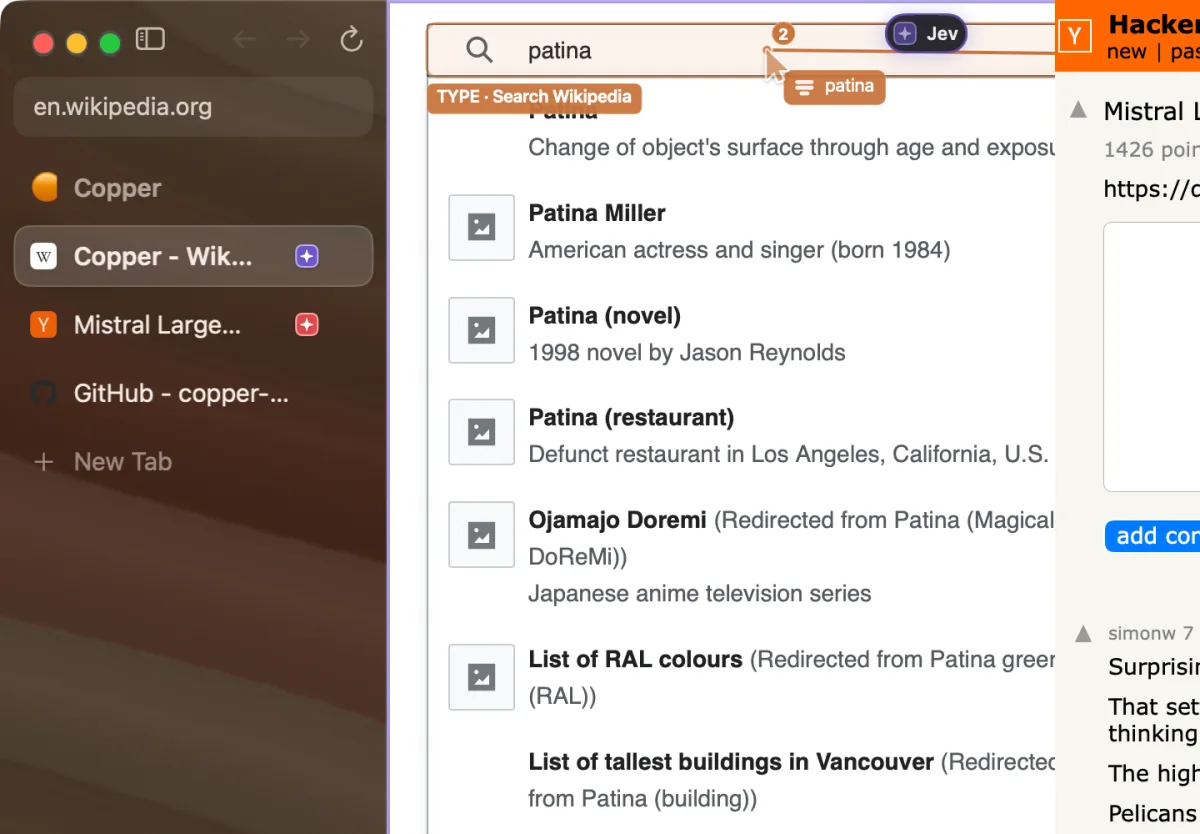
Copper runs an MCP server on your Mac. Claude Code, Codex, phi or any MCP client can drive the browser you're signed into, on the model and subscription you already pay for. Copper draws where each agent is about to click and puts the agent's badge on its tab. Press Stop to take the browser back.

Three agents working in three tabs at once.
Copper2.0 s
Polar11.6 s
Median time per completed task. Each goal was handed to the browser over MCP and run by its own driver (in Copper, jev_run). 28 web tasks, two rounds, on one Mac mini, 18 November 2026: Copper 1.0.20261117.114 and Polar 0.2.12.
  • Playwright MCP tool names. The tools use Playwright MCP's names and arguments, so a skill written for it works here unchanged.
  • One switch turns it on. Settings › Agents › Let agents drive this window. Set up connects Claude Code or phi in one press, and you never paste a token into a prompt.
  • A copper command for the shell, linked into your PATH by Homebrew. It never starts Copper on its own.
  • Loopback only. The server needs a bearer token that only your user can read. Pages in other browsers can't reach it.
$ copper health
Copper health: running: true
Jev mode: on

$ copper tabs
### Open tabs
- 0: (current) [Google] (https://www.google.com/)
- 1: [Copper - Wikipedia] (https://en.wikipedia.org/wiki/Copper)
- 2: [Mac - Apple] (https://www.apple.com/mac/)
- 3: [Hacker News] (https://news.ycombinator.com/)

$ 
Jev, built in

Jev acts in 300 ms, on your key.

Give Copper a goal. Jev reads the page's controls, picks an operation and an element in about 300 ms, and acts. A small model writes any text it has to type.

Jev runs on your own TypeSafe key. Any text it types comes from your Claude account or any OpenAI-compatible gateway.

  • TypeSafe key
  • Claude account
  • OpenAI-compatible gateway
  • Haiku, Sonnet or Opus
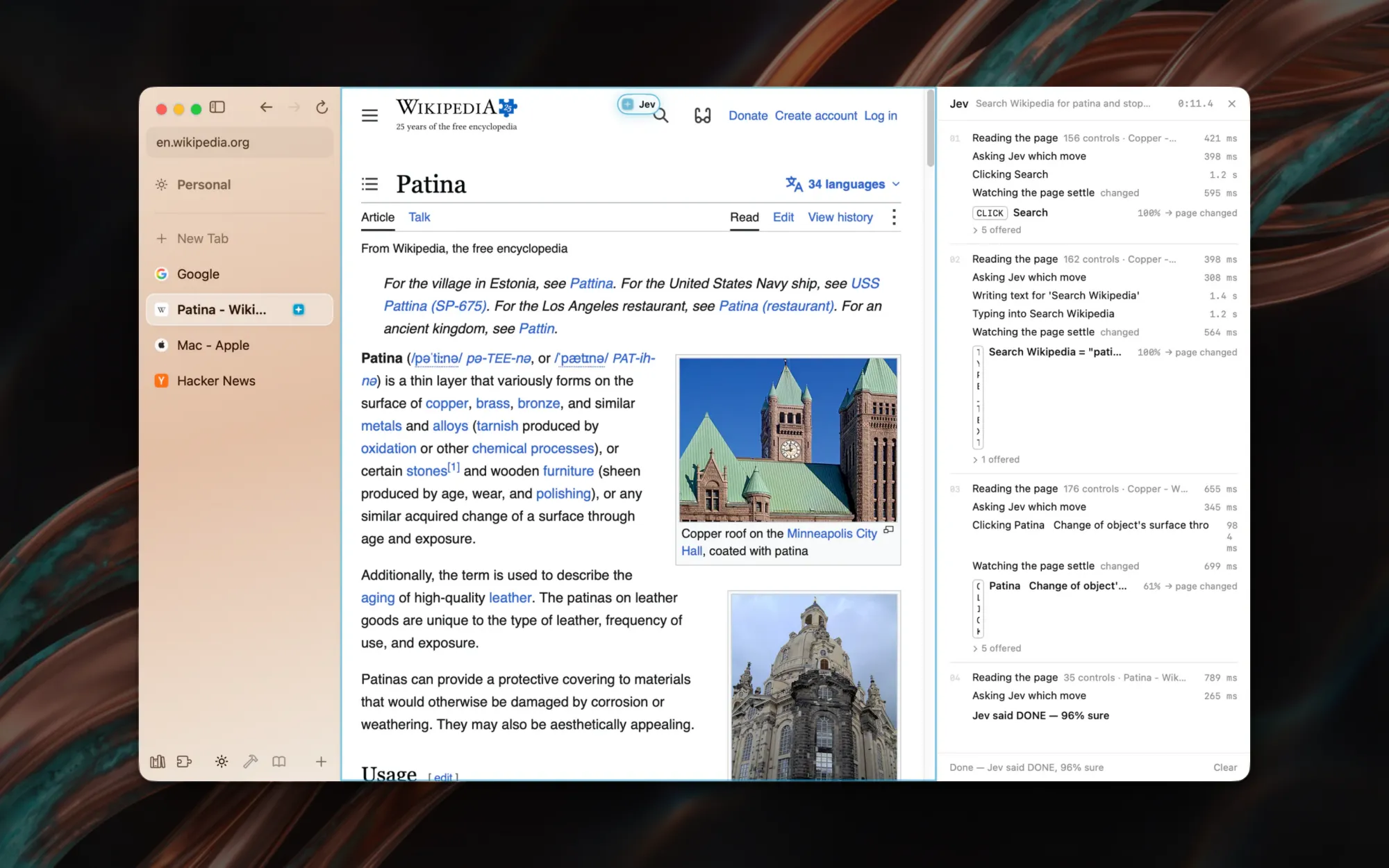
Copper on the Wikipedia article for Patina, with a small Jev pill at the top of the page and the driver timeline open on the right. The timeline lists each cycle: reading the page, asking Jev which move, clicking Search, typing “patina”, clicking the Patina result, and finally Jev said DONE, 96% sure.
Jev on Wikipedia's Patina article, with the driver timeline open on the right.

A run on Wikipedia.

We started on Wikipedia's Copper article and gave Jev one sentence, asking it to search for patina and stop at the article.

The run, recorded in Copper with the driver timeline open on the right.

Jev took three actions. It clicked Search, a small model wrote the word, and Jev picked the article from Wikipedia's suggestions. It stopped once the article was on screen.

  1. CLICKSearch372 ms
  2. TYPE“patina” into Search Wikipedia290 ms + 1.3 s text
  3. CLICKPatina, change of object's surface…268 ms
  4. DONE, 96% sureverify it yourself

DONE means Jev thinks it finished. The tool tells your agent to check the page before reporting that it worked.
$ copper run "Search Wikipedia for patina and stop when the article is visible"
### Jev run — done in 11.4 s (3 actions, 4 decisions)
Jev said DONE, 96% sure

1. CLICK Search (100%, 372 ms) → page changed
2. TYPE_TEXT Search Wikipedia = "patina" (100%, 290 ms + 1296 ms text) → page changed
3. CLICK Patina   Change of object's surface through age and exposure (61%, 268 ms) → page changed

### Page
- URL: https://en.wikipedia.org/wiki/Patina
- Title: Patina - Wikipedia

$ 
Sign-in for agents

Agents log in, 2FA included.

Connect Bitwarden and your agents can use your saved logins and two-factor codes, on your Mac or on a headless Mac mini. The agent never sees the password, and you decide which logins it can use.

  • You choose what's shared. Logins in Bitwarden's Agents folder are shared. A copper-agent: deny field blocks a login for good. Agents can't change either rule.
  • Nothing secret comes back. A sign-in reports which fields it filled. It leaves out the password, the code and the session key.
  • Cards and addresses too, with browser_autofill. Copper uses Bitwarden's bw client, so there is no extension to install.
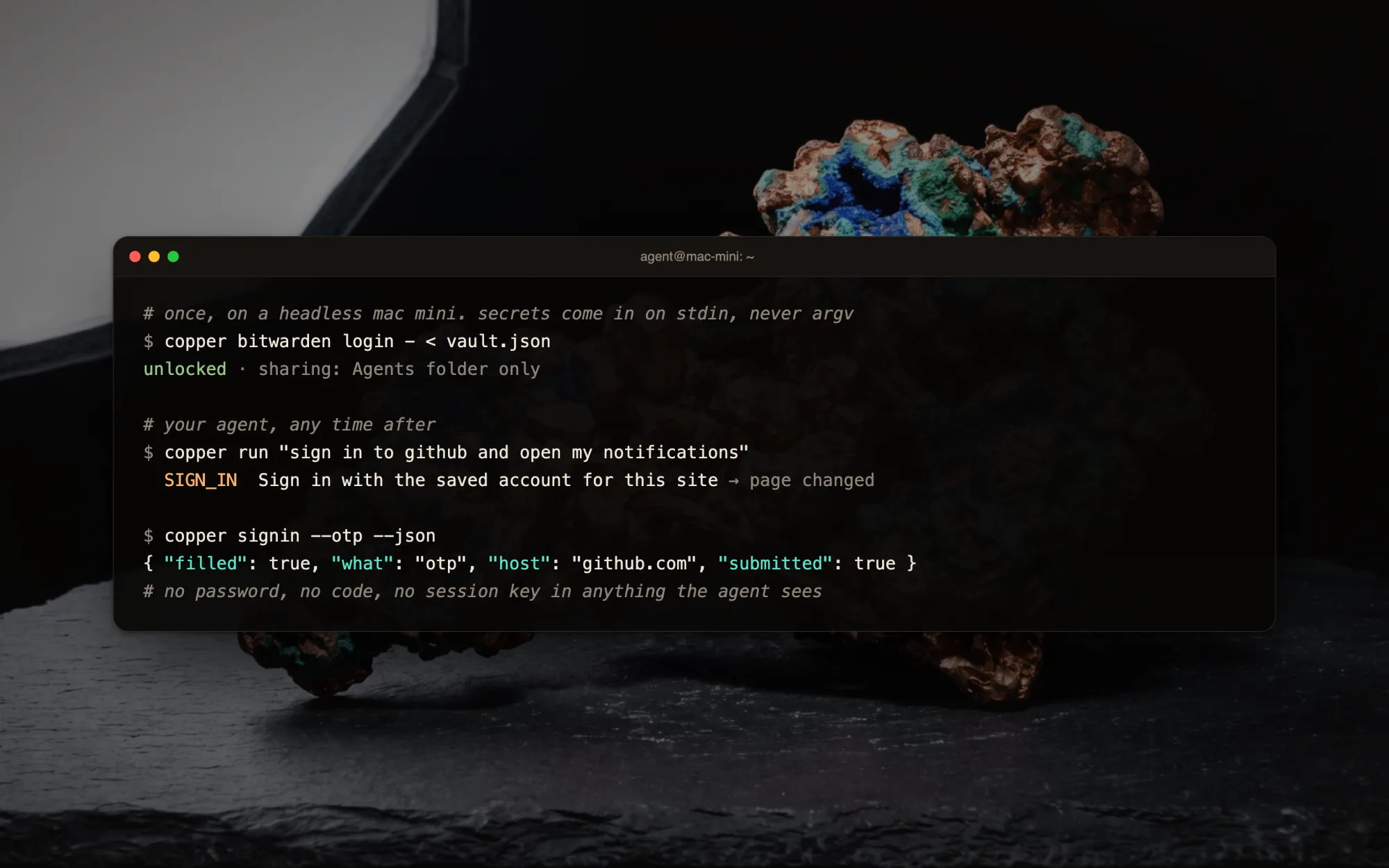
A terminal on a Mac mini. copper bitwarden login reads the vault from stdin and unlocks, sharing the Agents folder only. Then copper run “sign in to github and open my notifications” uses SIGN_IN with the saved account, and copper signin --otp fills the one-time code. A comment notes there is no password, code or session key in anything the agent sees.
Set up once on a headless Mac mini. After that any agent can sign in.
The browser

Arc's features, on WebKit.

Copper has spaces with their own animated themes, Favorites, Saved and Today, folders, tab groups, split view, a ⌘K command bar and auto-archive.

It uses the WebKit that ships with macOS, so it doesn't bundle a copy of Chromium.

  • ⌃NNew space
  • ⌃1Jump to a space
  • ⇧⌘DSplit view
  • ⌘KFind any tab
Switching spaces. Each space has its own sidebar theme and its own tabs.

Try it here.

A small working copy of Copper's window.

Personal

What's built in.

Copper has no toolbar, start page, suggestion feed or account. Ad blocking, reading mode, element hiding and picture in picture are built in, and most have a shortcut.

Switching tabs, finding one with ⌘K, changing space and moving the tabs to the top. Recorded in Copper.
  • One field

    ⌘L

    It takes addresses and searches. Nothing you type is sent anywhere until you press Return.

  • Tabs on top or on the left

    ⇧⌘S

    Pinned tabs shrink to a letter. Tabs from your last session don't load until you click them.

  • Spaces

    ⌃N

    Each space is a set of tabs with a name, an icon and a sidebar colour. A space can have its own profile.

  • Find any tab

    ⌘K

    Lists your open tabs by name as you type, including tabs in other spaces.

  • Hide parts of a page

    ⇧⌘H

    Click a cookie banner or a newsletter overlay to hide it. On your next visit it is hidden before the page draws.

  • Reading mode

    ⇧⌘R

    Strips a page down to the article.

  • A built-in ad blocker

    Trackers and ad networks are blocked at the network level, so their content never loads. It is on by default and you can turn it off per site.

  • Picture in picture

    ⇧⌘P

    Moves the video into a small window that stays on top of other apps.

  • Passwords in your keychain

    ⌥⌘L

    Copper saves a password after the sign-in works. It offers it when you click the field and fills it when you pick it. macOS encrypts it.

  • Automatic updates

    A new build is downloaded and verified in the background. Copper restarts only when you tell it to.

Flow

Import from Chrome or Arc.

Flow is one button. It reads the other browser's files on your Mac without changing them. Imported tabs don't load until you open them. macOS asks you once before Copper can use the other browser's key.

Chrome or Arc Copper What comes over
  • Open tabs and windowsas sleeping tabs
  • Arc spaces, pinned tabs, tab groupseach a new space
  • Bookmarks and historyfor address suggestions
  • Passwords and signed-in stateinto the keychain
  • Google Password Manager passkeysafter one approval
  • Extensionsreinstalled in the background
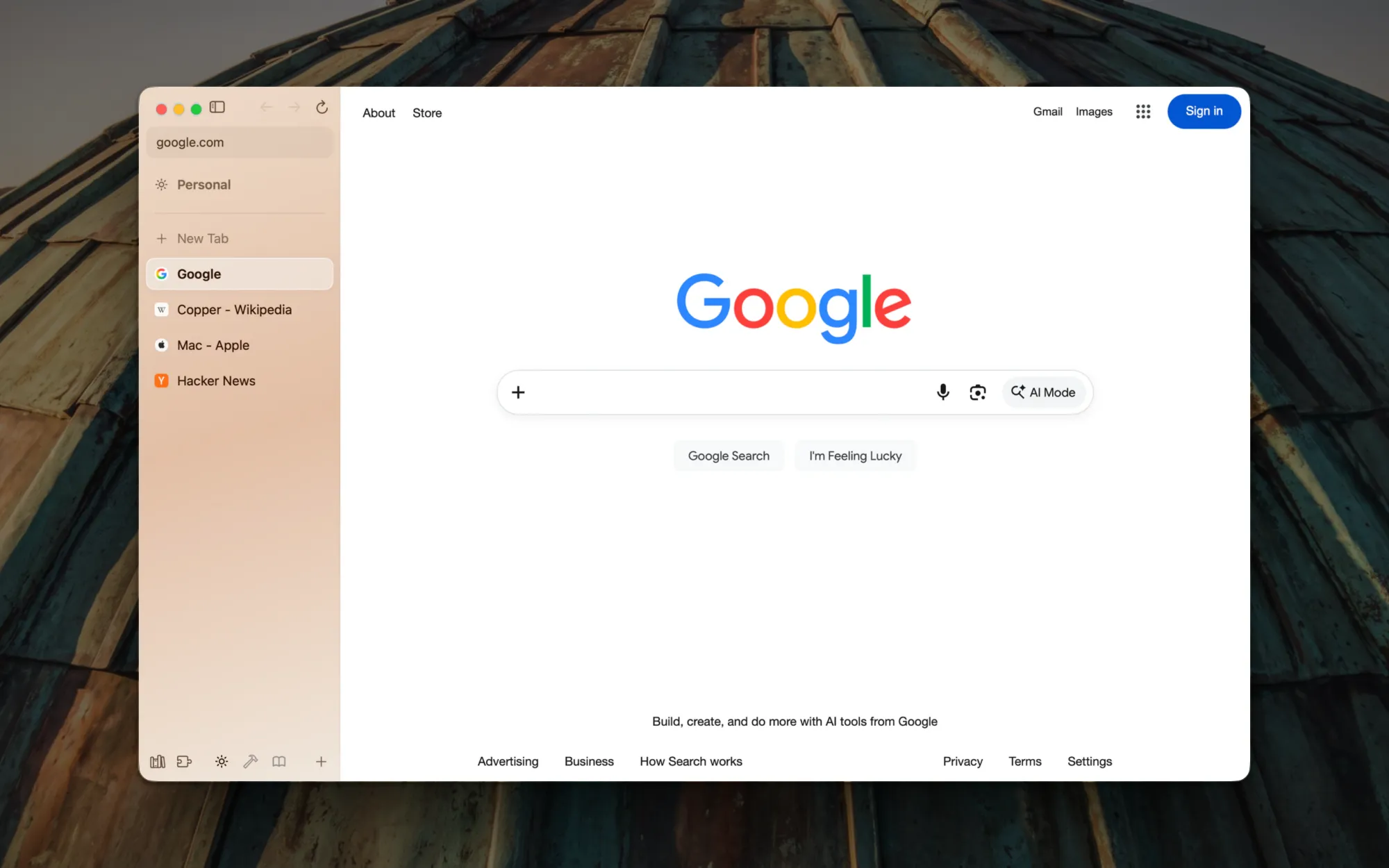
A Copper window on google.com in front of a patina-green copper dome. The sidebar on the left, in the Personal space's copper colour, holds the address, the space's name and four tabs: Google, Copper on Wikipedia, Mac on apple.com and Hacker News. There is no toolbar.
The Copper window has tabs on the left and the page.

Chrome extensions run here

Paste a Chrome Web Store link, or press Add on the extension's page. It runs on WebKit's own extension engine, the one Safari uses, and Copper fills in the Chrome APIs WebKit lacks. Needs macOS 15.4 or later.

Canvas

A multiplayer canvas in a tab.

Canvas is a whiteboard that opens in a tab. It holds stickies, text, frames, arrows, images and live websites. Your Personal canvas is stored on your Mac and works offline.

Link Copper Cloud to share a board and you see everyone's cursors, including the agents'. The ⌘E agent, MCP agents and the copper command can all read and write boards. People without Copper can join from any browser with Canvas App.

  • ⌃⇧ENew canvas
  • ⇧⌘OPersonal canvas
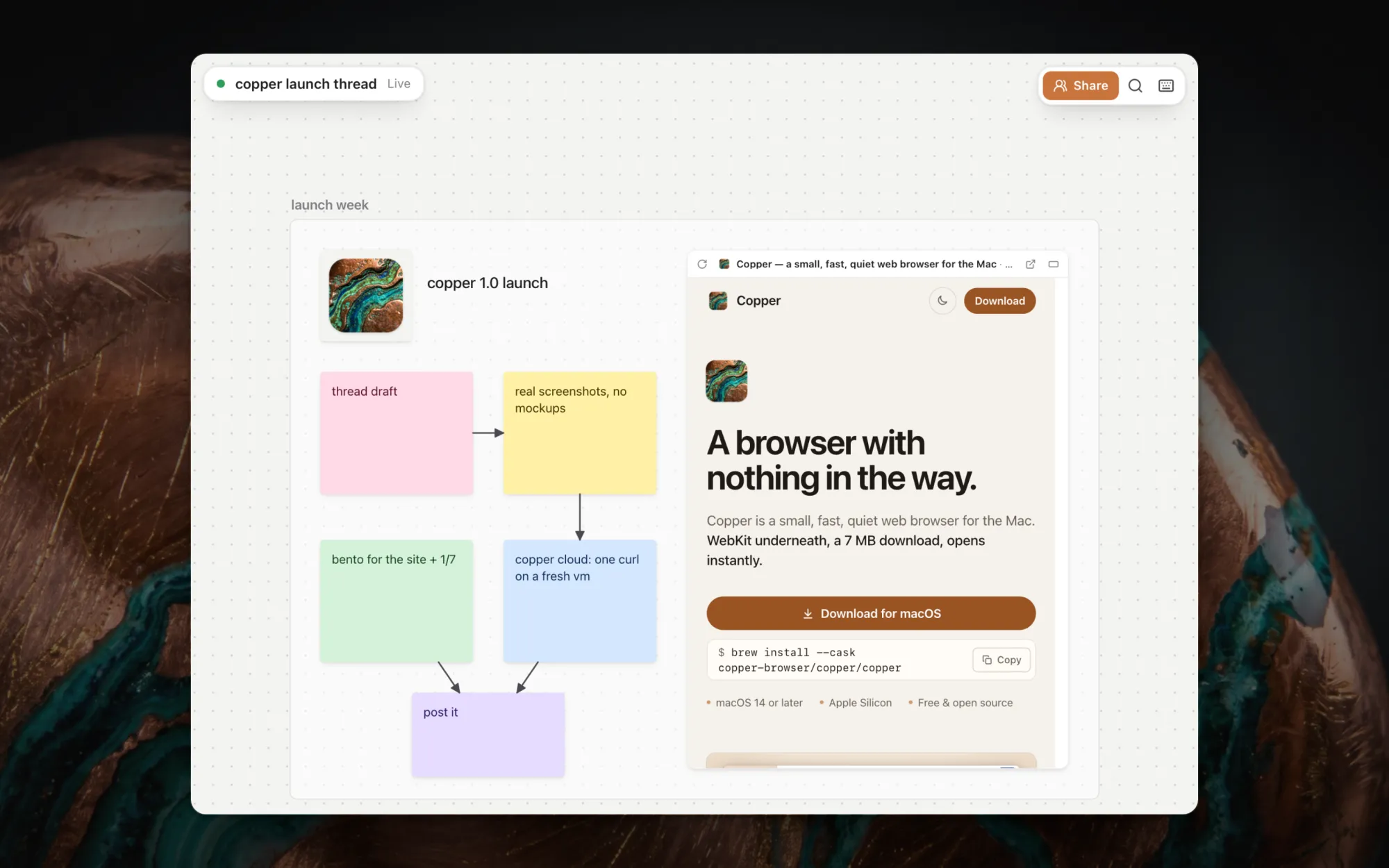
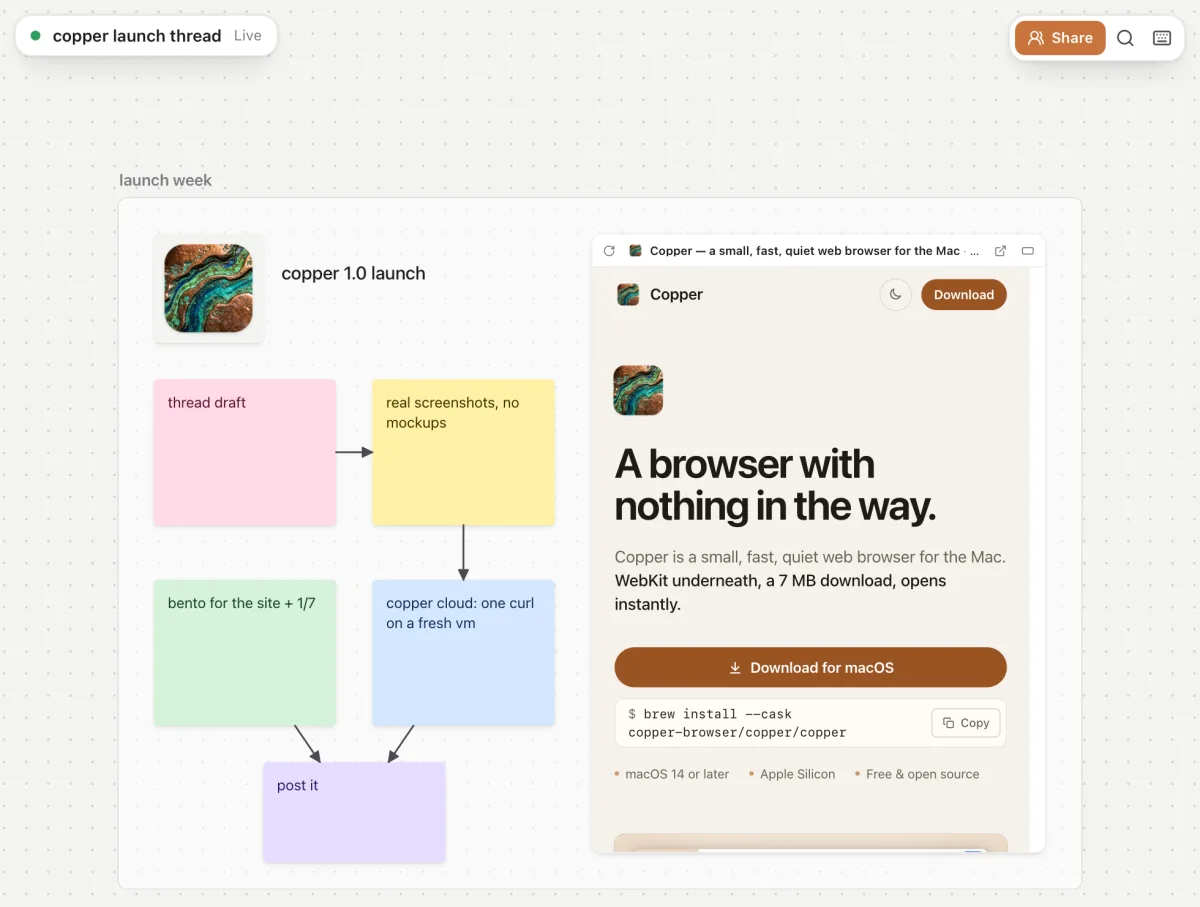
A shared canvas called copper launch thread, marked Live, with a Share button. Inside a frame titled launch week: the Copper icon, stickies reading thread draft, real screenshots no mockups, bento for the site, copper cloud one curl on a fresh vm and post it, joined by arrows, beside a live copy of the Copper website.
An agent laid out our launch on this board.
Canvas App

Canvas App runs in any browser.

The canvas is its own open source project, canvas-app. Copper ships its page, and Canvas App is that page running in Chrome, Firefox, Safari or Edge with no install. It stores your boards in the browser, works offline and joins shared boards with live cursors.

MITAll of the canvas code is in one MIT licensed repository.
One pageCopper on Mac, Copper on Linux and Canvas App all run this page, so one fix reaches all three.
One file to hostThe app is one HTML file. You can serve it from the server that hosts your canvases.
Copper Cloud

Run your own Copper Cloud.

Copper Cloud is the sync server. It is one Rust binary and Postgres, and it installs with one command on any Linux machine or with Terraform on AWS. It syncs spaces, tabs, bookmarks and history between your Macs and hosts live canvas rooms.

curl -fsSL https://raw.githubusercontent.com/copper-browser/copper-cloud/main/install.sh | sudo sh
  • Off until you turn it on. You pick what syncs, and passwords are never synced.
  • Pinned by its certificate. Copper shows the fingerprint before it sends anything.
  • Encrypted at rest with your account's key, on a machine you run.
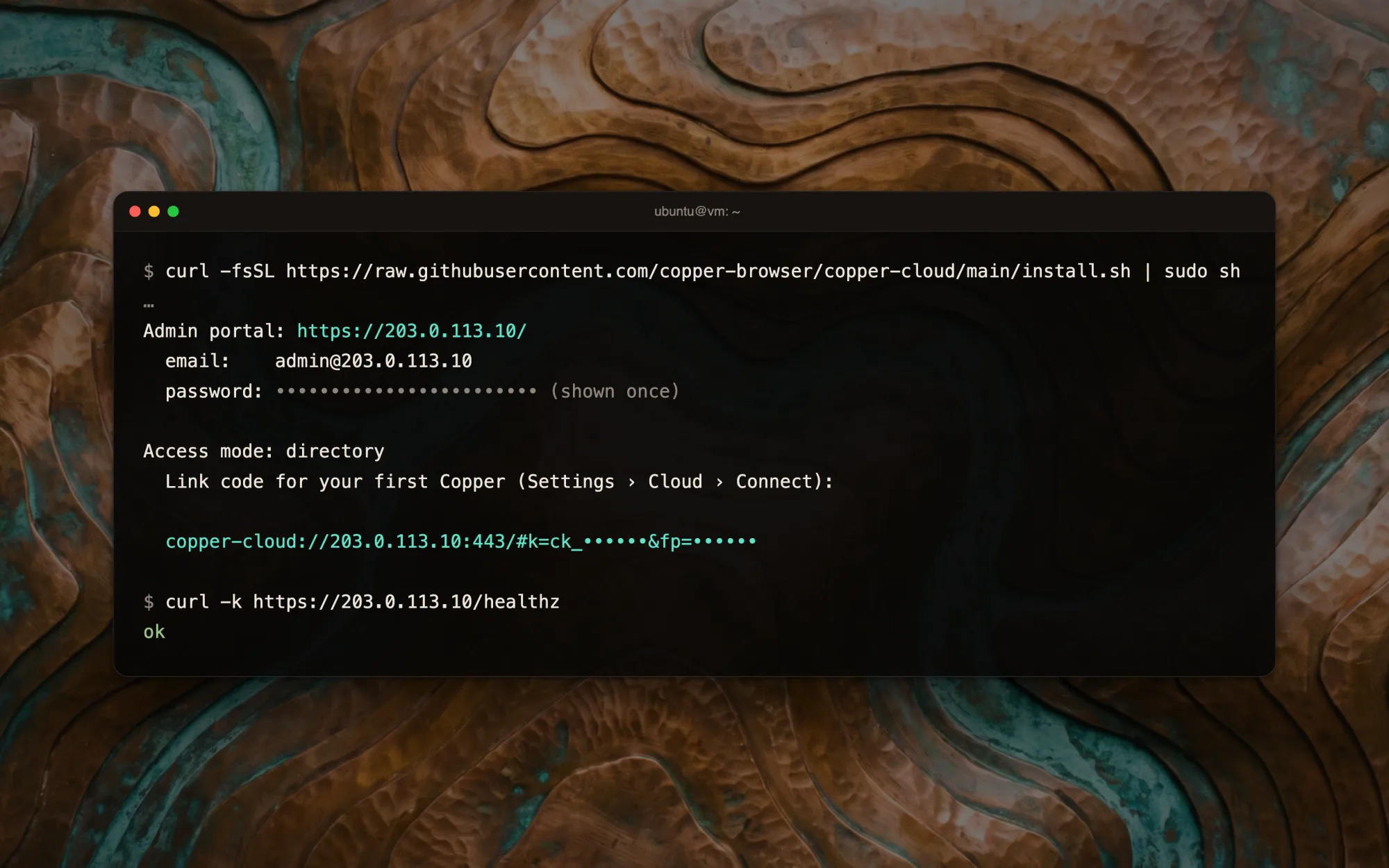
A terminal on a fresh Ubuntu VM. The one-line install prints the admin portal address and a one-time password, the access mode, and a copper-cloud:// link code to paste into Copper's Settings › Cloud › Connect. A health check answers ok.
One command on a fresh VM, then paste the link code into Settings › Cloud.
Privacy

What leaves your Mac.

Copper requests the pages you ask for, their icons, and one update check a day. When you run Jev, the page's controls and your goal go to TypeSafe on your own key, and the model provider you chose writes the text it types. Copper Cloud is off until you link a server you run.

AccountsCopper has none. Copper Cloud accounts live on your own server.
TelemetryCopper sends no analytics and no crash reports.
ServersWe don't run one. Your tabs, history and passwords stay on the Mac or on a machine you run.
Where everything is
WhatWhere it isWho can read it
PasswordsThe macOS login keychain, as ordinary keychain items tagged Copper, or your Bitwarden vault if you connect oneCopper. Any other app triggers the system's permission dialog.
History, bookmarks, open tabs, hidden elementsSmall JSON files in ~/Library/Application Support/Copper/You.
Cookies and site dataWebKit's own store for the appThe sites that set them, as in any browser.
ExtensionsUnpacked in Copper's own folder, their data in WebKit's extension storeEach extension, within the permissions you accepted.
Copper Cloud, only if you link itThe parts you switched on, on the instance you linked, encrypted at rest with your account's keyYou, and that instance's operator.
Jev, only while it runsThe page's controls and your goal go to TypeSafe on your key. The model you picked writes the text to type, on your Claude account or your gatewayYou, and those providers.
Anything elseNot stored or sent.No one.

A private tab (⇧⌘N) has its own cookie jar and leaves nothing behind when it closes.

Install.

For macOS, Windows and Linux. On a Mac, Copper updates itself. On Windows and Linux, run the install line again to upgrade.

A notarized Mac build is coming soon. For now, build Copper yourself from source. You need macOS 14 or later and Xcode 16.

git clone https://github.com/copper-browser/Copper.git && cd Copper && ./build.sh && open build/Copper.app

It builds Copper.app into the build folder and opens it. The downloads below work today too and are not notarized yet. Source and build notes on GitHub

Homebrew Recommended

brew install --cask copper-browser/copper/copper

Also links the copper command into your PATH.

One-line installer

curl -fsSL https://github.com/copper-browser/Copper/releases/latest/download/copper-install.sh | sh

Works without Homebrew.

Download the app

Intel Mac? Download for Intel, or see all downloads.

Unzip it and drag Copper.app to Applications.

About the first launch. Copper builds are ad-hoc signed and not yet notarized. Homebrew and the installer clear the quarantine flag for you. After a manual download, run this once, or right-click Copper and choose Open:

xattr -cr /Applications/Copper.app
Swift and WebKit on the Mac. Rust with WebView2 on Windows and WebKitGTK on Linux.
Open source

MIT licensed.

The browser, the server and the canvas are MIT licensed. Issues and pull requests are welcome.

Built by Collin Rijock and Felipe Arce at ShellHacks at FIU.